 Southwest
Environmental LimitedSouthwest
Environmental Limited
Southwest
Environmental LimitedSouthwest
Environmental Limited| London |
| 02076 920 670 |
| Exeter |
| 01392 927 961 |
| Manchester |
| 01612 970 026 |
| Bristol |
| 01173 270 092 |
An RF (Radio Frequency) baseline study is a field-based spectrum analysis that establishes the initial state of the wireless environment across a site prior to the installation of new networks, CCTV bridges, or point-to-point data links.
Before deploying mission-critical wireless infrastructure, it is vital to understand the existing RF landscape to avoid interference, radar congestion, and signal degradation. Our environmental consultants utilize specialized spectrum analysis tools to provide actionable data on the cleanest channels and optimal antenna placements for your specific environment.
The 2.4 GHz and 5 GHz bands are the most heavily utilized frequencies for standard Wi-Fi and wireless CCTV bridging. Our baseline studies sweep these frequencies to identify existing network congestion, hidden networks, and overlapping channels. For 5 GHz deployments, our equipment actively monitors the spectrum for DFS (Dynamic Frequency Selection) radar signatures—such as military, aviation, or meteorological radar—which can legally force your equipment offline if not properly accounted for during the planning phase.
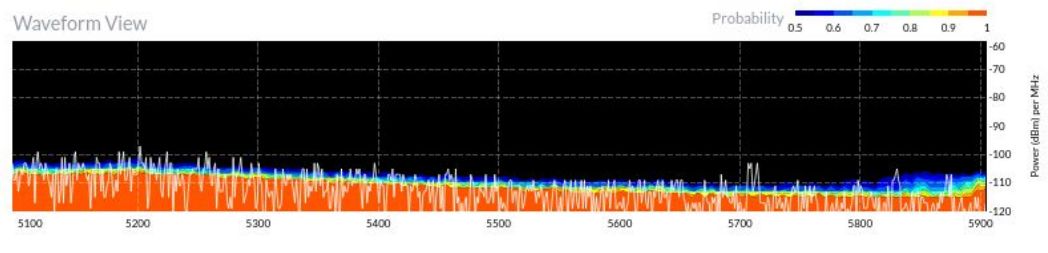
When conducting baseline studies at highly regulated locations such as Ministry of Defence (MoD) facilities, military bases, or commercial airports, standard Wi-Fi scanning tools are entirely insufficient. These environments frequently operate complex proprietary radio systems, localized jammers, and high-powered communication networks that do not broadcast standard Wi-Fi beacons.
To safely survey these environments, we utilize hardware-level RF spectrum analyzers configured for unrestricted, licensed-mode sweeping. This allows us to map the raw radio spectrum across the entire 5 GHz to 6 GHz range, detecting raw radar spikes and military interference that commercial scanners miss. This specialized data ensures your planned wireless infrastructure operates reliably without stepping on critical government or aviation frequencies.
For high-capacity, short-range point-to-point links, higher frequency millimeter-wave bands (such as 60 GHz) are often utilized to bypass lower-band congestion. A crucial part of our baseline assessment for these ultra-high frequencies involves calculating atmospheric attenuation.
At these higher frequencies, signal strength is severely depleted by oxygen absorbance (O2 resonance). Our environmental baseline reports factor in these unique physical propagation characteristics, alongside localized environmental data and line-of-sight physical barriers, to guarantee the stability and uptime of your high-frequency infrastructure.
Following the field study, we provide a comprehensive technical report detailing the current RF noise floor, active interference sources, and strategic recommendations for frequency planning. Installing wireless infrastructure without a baseline survey often leads to dropped packets and intermittent outages—let us ensure your project is built on a clear foundation.