 Southwest
Environmental LimitedSouthwest
Environmental Limited
Southwest
Environmental LimitedSouthwest
Environmental Limited| London |
| 02076 920 670 |
| Exeter |
| 01392 927 961 |
| Manchester |
| 01612 970 026 |
| Bristol |
| 01173 270 092 |
As we all learnt in school hydrocarbons are substances with a number of carbon atoms with hydrogen atoms stuck on the out side. Dependent on the number of Carbon Atoms, the Hydrocarbon will have a different name. There are some exceptions to this as there are isomers of some hydrocarbons, but if we want to know what type of hydrocarbon we have collected in a water sample or a soil sample, then first of we need to know which "fraction we have".
To do this we need to test our sample using GC / FID or some other method that will reveal what type of hydrocarbon you have. This is important as there are lots of lots of different types of hydrocarbon:
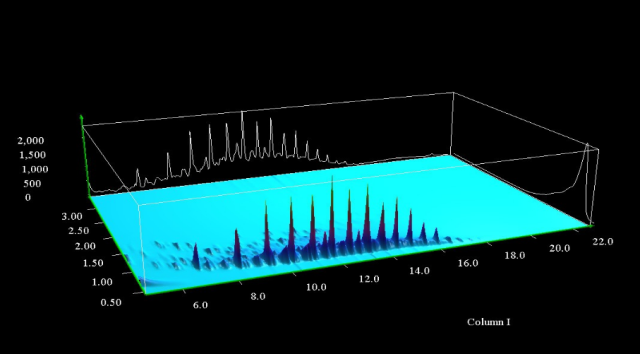 When we test an oil we get a graph similar to the one to the left
it "flags up" what type of hydrocarbons you have.
When we test an oil we get a graph similar to the one to the left
it "flags up" what type of hydrocarbons you have.
We can see here that the hydrocarbon tested has hydrocarbons (light blue
graph) in the
range of C6 to C16 that is they have between 6 and 16 carbon atoms per
hydrocarbon.
This graph is for diesel. We could test another sample of diesel and get
a slightly different result, but the overall shape of the graph would be
similar.
Images Courtesy of:
RAE System PID Handbook
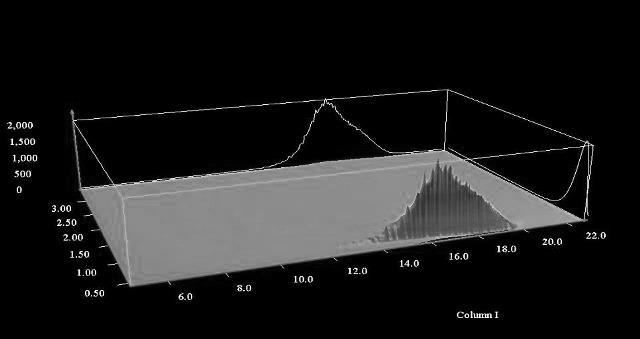
Although interest the above theory no needs to be used to try and diagnose what hydrocarbons we have in our oil or water sample, this is slightly problematic, because when looking at wastes there are a whole bunch of hydrocarbons all smooshed together and we end up with a very untidy looking chromatograph, that can only lead to broad conclusions.
In this case we have to try and sort out the various peaks, and make an
estimate of what might be in the sample. In a water sample with oils the
physical appearance can help to diagnose, but in soils it is more difficult.
This chromatograph (grey background). . graph is for lube oil. With a range of
approximately C14 to C18.
As chains become longer the hydrocarbon become more viscous, by the time
we get to Hydrocarbons with a C number of 24 (C40) we may see some
solids, although liquids are also still present.
Some very complex hydrocarbons are flakey in texture.